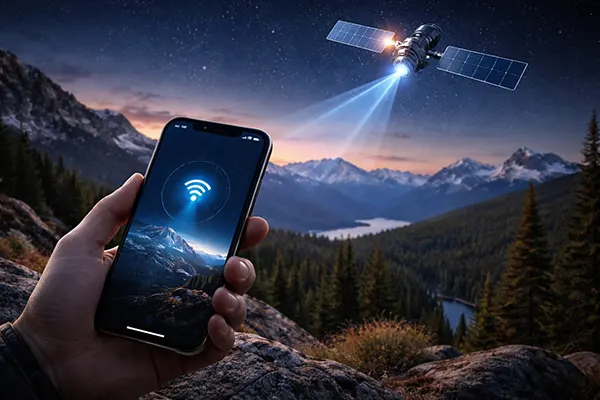
By 2026, satellite connectivity on iPhone has moved beyond a niche emergency option into a practical tool for everyday safety, travel and communication in areas with limited coverage. Apple has gradually expanded its satellite-based services, making them more reliable, faster and available in more regions. Understanding how Emergency SOS, satellite messaging and Find My work in real conditions helps users decide when these features genuinely matter and when traditional connectivity still remains essential.
How Satellite Connectivity Works on iPhone in 2026
Modern iPhones use low-earth orbit satellite networks to establish communication when cellular and Wi-Fi signals are unavailable. Unlike standard mobile networks, these satellites move quickly across the sky, meaning the device must guide the user to maintain alignment for a stable connection. Apple has refined this process with clearer on-screen instructions and faster acquisition times compared to earlier versions.
In 2026, satellite communication is still limited in bandwidth, which explains why features focus on text rather than voice or video. Messages are compressed, prioritised and routed through ground stations before reaching emergency services or contacts. This ensures reliability even in remote environments such as mountains, deserts or offshore locations.
Coverage has expanded significantly across North America, Europe and selected regions of Asia-Pacific. However, performance can still vary depending on terrain, weather conditions and obstacles like dense forests or urban structures. Users should treat satellite communication as a backup rather than a replacement for mobile networks.
Limitations and Technical Considerations
Despite improvements, satellite features are not instant. Sending a message may take from a few seconds to several minutes depending on signal strength and satellite position. This delay is normal and should be expected in emergency scenarios.
Battery consumption is another factor. Establishing a satellite connection requires higher power usage compared to standard messaging. In critical situations, preserving battery life becomes essential, especially during extended outdoor trips.
Finally, not all features are globally available. Regional regulations, partnerships with satellite providers and emergency service integration affect accessibility. Before travelling, users should verify whether satellite functions are supported in their destination.
Emergency SOS via Satellite: Practical Value in Critical Situations
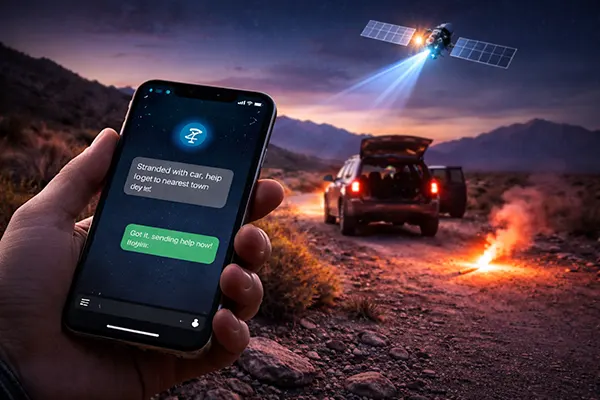
Emergency SOS remains the most important satellite feature. In 2026, it allows users to contact emergency services even without mobile coverage by sending structured messages that include location, battery level and medical information if configured in advance.
The system uses guided prompts to collect essential details quickly. Instead of writing long messages, users answer simple questions about their situation, such as injury type or immediate danger. This reduces errors and speeds up communication with responders.
In real-world scenarios, this feature has proven useful during hiking accidents, vehicle breakdowns in remote areas and maritime incidents. Its reliability has improved thanks to better positioning accuracy and more consistent satellite handovers.
What Happens After Sending an SOS Request
Once the SOS message is transmitted, it is routed to the nearest available emergency response centre or relay service. In regions without direct integration, trained operators interpret the message and contact local authorities on behalf of the user.
Users receive updates confirming message delivery and response status. In some cases, follow-up questions may be sent to gather additional information, creating a basic but effective two-way communication channel.
The system also shares location data with emergency contacts via Find My, ensuring that family members or friends are aware of the situation. This adds an extra layer of reassurance, especially during prolonged rescue operations.
Satellite Messaging and Find My: Everyday Scenarios Beyond Emergencies
Beyond emergencies, Apple has expanded satellite messaging to support basic communication with contacts. In 2026, users can send short text messages when off-grid, making it useful for travellers, campers and remote workers.
Unlike traditional messaging, satellite texts are optimised for brevity. The interface encourages concise communication, which improves delivery speed and reliability. While not suitable for continuous conversations, it serves as a practical check-in tool.
Find My integration has also evolved. Users can share their location via satellite at intervals, allowing others to track their position even without network coverage. This is particularly relevant for long-distance hiking, sailing or exploring sparsely populated regions.
Where These Features Are Genuinely Useful
Satellite functions provide clear benefits in outdoor environments where coverage gaps are common. Mountain regions, national parks and remote coastlines are typical examples where standard connectivity cannot be relied upon.
They are also valuable during infrastructure outages. Severe weather events, natural disasters or network failures can disrupt mobile service, making satellite communication a temporary but reliable alternative.
However, in urban settings, their usefulness is limited. Buildings and interference reduce signal quality, and traditional networks remain faster and more efficient. Understanding this distinction helps users set realistic expectations and use the technology appropriately.