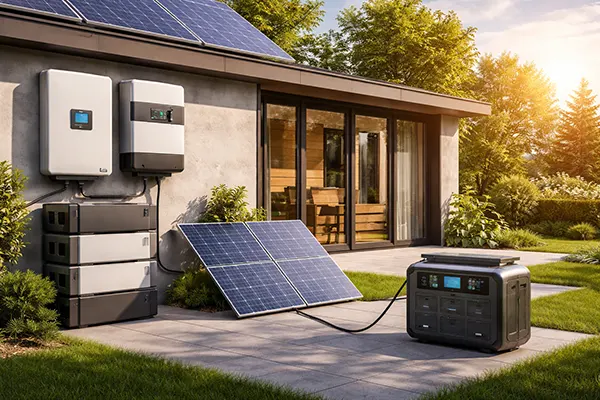
Power outages are no longer rare events but part of everyday risk management for households across Europe. Rising grid instability, extreme weather, and higher energy costs have pushed many homeowners to look for alternatives that do not rely on petrol or diesel generators. In 2026, it is entirely realistic to assemble a quiet, efficient, and scalable home backup system using batteries, solar panels, and smart inverters. The key is understanding what actually works in practice, how components interact, and where limitations still exist.
Battery-Based Backup Systems: Core of Modern автономні рішення
At the centre of any generator-free setup is a battery system. In 2026, lithium iron phosphate (LiFePO4) batteries dominate the residential segment due to their long lifespan, safety profile, and stable performance under repeated cycles. Typical home systems range from 5 kWh to 20 kWh, enough to support essential appliances for several hours or even days, depending on usage.
Unlike older solutions, modern battery units integrate battery management systems (BMS) that optimise charging, prevent overheating, and extend operational life beyond 6,000 cycles. This makes them a realistic long-term investment rather than a temporary workaround. Brands such as Tesla Powerwall, BYD Battery-Box, and EcoFlow Power Kits have set practical benchmarks for reliability and modular expansion.
Another important factor is hybrid inverters. These devices allow seamless switching between grid power, battery storage, and renewable sources. In a blackout, a properly configured system can switch in milliseconds, ensuring that lighting, internet routers, refrigeration, and security systems continue to operate without interruption.
What a Typical Home Battery Setup Can реально Support
A well-sized 10 kWh system can power essential loads such as LED lighting, Wi-Fi routers, laptops, and a refrigerator for 10–20 hours depending on consumption. For households with energy-efficient appliances, this often covers overnight outages without noticeable disruption.
However, high-demand devices such as electric ovens, air conditioning units, and electric heaters require careful planning. Running these directly from batteries significantly reduces autonomy. In practice, users prioritise circuits through a backup panel, selecting only critical loads to maximise efficiency.
Scalability is another advantage. Many 2026 systems allow stacking additional battery modules without replacing the core unit. This means homeowners can start with a basic setup and expand it as energy needs or budget allows, avoiding large upfront costs.
Solar Integration: Extending Autonomy Beyond the Grid
Adding solar panels transforms a backup system from temporary support into a semi-independent energy source. In 2026, residential solar efficiency has improved to 22–24% in commercially available panels, making even small roof installations viable for meaningful energy generation.
During daylight hours, solar panels can directly power household loads while simultaneously charging batteries. This significantly extends the duration of backup capability during prolonged outages. Even in cloudy regions such as Northern Europe, partial generation still contributes to system resilience.
Modern hybrid systems also include smart energy management software. These tools prioritise solar usage, schedule battery charging during off-peak tariffs, and optimise discharge patterns. This not only improves backup performance but also reduces electricity bills in normal conditions.
Realistic Expectations from Solar Backup in 2026
A typical 3–5 kW solar array can generate between 10 and 20 kWh per day in favourable conditions. This is often enough to fully recharge a home battery and cover essential daily consumption. However, production varies significantly with season and location.
Winter performance remains the main limitation. Short daylight hours and lower sun angles reduce output, meaning solar alone cannot guarantee full independence year-round. For this reason, most systems are designed as hybrid solutions rather than standalone solar-only setups.
Despite these constraints, solar integration remains one of the most practical ways to reduce reliance on the grid. Over time, it also offsets installation costs by lowering electricity expenses, making it both a resilience and financial decision.
Portable Power Stations and Modular Systems
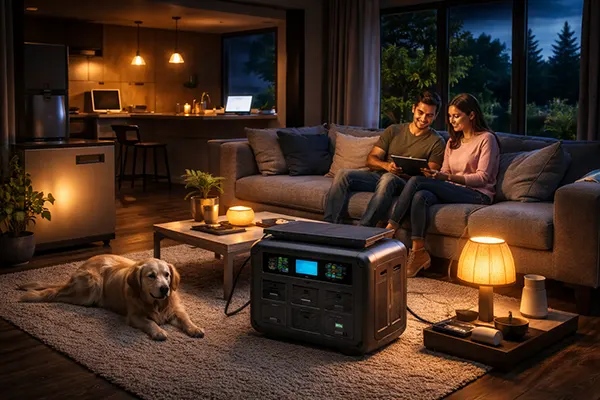
Not every household requires a fixed installation. Portable power stations have become significantly more capable by 2026, offering capacities from 1 kWh to over 5 kWh in compact, mobile units. These are especially useful for apartments, renters, or as supplementary backup.
Unlike traditional uninterruptible power supplies (UPS), modern portable stations support higher output loads, multiple AC outlets, and fast charging options including solar input. Devices from manufacturers such as Bluetti, Jackery, and EcoFlow can power small appliances, communication devices, and even some kitchen equipment for limited periods.
Another trend is modular energy systems. These combine portable units with expandable battery packs and optional solar panels. Users can build a flexible system that adapts to changing needs without committing to a full-scale installation from the start.
When Portable Systems Make More Sense Than Fixed Installations
Portable systems are particularly useful in situations where permanent wiring is not allowed or practical. For example, tenants in rented properties can maintain backup power without modifying the building’s electrical infrastructure.
They also serve as redundancy layers. Even households with fixed battery systems often keep a portable unit for critical devices, ensuring additional resilience in case of system maintenance or unexpected load increases.
However, portability comes with trade-offs. These units typically have lower capacity and limited output compared to fixed systems. For full-home backup, they are not sufficient on their own but work well as part of a broader energy strategy.