Modern data centres consume vast amounts of electricity, and a significant share of that energy is dedicated to cooling rather than computing. As artificial intelligence, cloud services, and high-performance computing continue to expand in 2026, traditional air-cooling methods are increasingly reaching their practical limits. Operators are therefore investing in advanced cooling systems that improve efficiency, reduce environmental impact, and support denser server deployments. From direct liquid cooling to experimental underwater facilities, cooling technology has become one of the most important areas of innovation in digital infrastructure.
Why Traditional Cooling Methods Are Facing New Challenges
For many years, computer rooms relied primarily on chilled air circulated through raised floors and ventilation systems. This approach worked effectively when servers generated relatively modest amounts of heat. However, modern processors used for artificial intelligence workloads can consume several hundred watts per chip, creating thermal loads that are difficult to manage using air alone.
Data centre operators are also under pressure to reduce energy consumption. Cooling systems can account for a substantial percentage of a facility’s total electricity use. As energy costs remain a major concern across Europe, North America, and Asia, improving cooling efficiency directly affects operational expenses and sustainability targets.
Another challenge is space utilisation. Businesses increasingly seek higher computing density within existing facilities. Packing more servers into the same area generates greater heat concentration, making conventional air-cooling systems less effective and encouraging the adoption of alternative technologies.
The Growing Impact of AI Infrastructure
The rapid adoption of generative AI has transformed data centre design. Graphics processing units and specialised AI accelerators generate considerably more heat than many traditional server components. Maintaining stable operating temperatures is essential for reliability and performance.
Hyperscale operators such as Microsoft, Google, Amazon, and Meta have expanded investments in advanced thermal management technologies to support AI clusters. These installations often require cooling systems capable of removing heat directly from processors rather than relying solely on ambient air circulation.
Without effective cooling, excessive temperatures can reduce hardware lifespan, increase failure rates, and limit computational performance. As a result, thermal management has become a strategic factor rather than merely a facility maintenance issue.
Liquid Cooling as the New Industry Standard
Liquid cooling has emerged as one of the most practical solutions for high-density computing environments. Because liquids transfer heat far more efficiently than air, they can remove large amounts of thermal energy from processors while using less power than many traditional cooling systems.
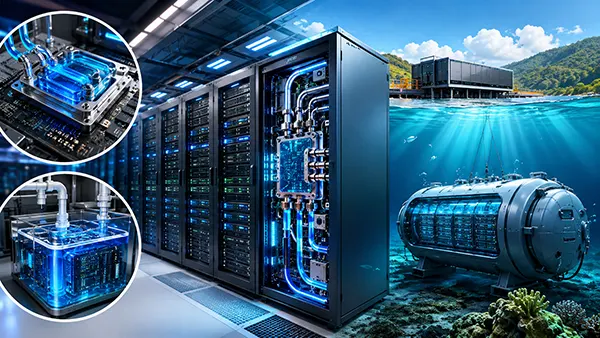
One widely adopted approach is direct-to-chip cooling. In this configuration, coolant flows through specialised cold plates attached directly to processors and accelerators. Heat is transferred into the liquid and then removed through external heat exchange systems.
Another method is immersion cooling, where entire servers are placed inside tanks filled with non-conductive dielectric fluid. The liquid absorbs heat directly from electronic components, reducing the need for mechanical fans and improving overall energy efficiency.
Benefits and Limitations of Liquid-Based Systems
The primary advantage of liquid cooling is efficiency. Facilities can often achieve lower Power Usage Effectiveness (PUE) values because less electricity is required for thermal management. This can significantly reduce long-term operating costs.
Liquid cooling also enables higher rack densities. Organisations running advanced AI models, scientific simulations, or large-scale analytics can deploy more computing power within the same physical footprint, maximising data centre capacity.
Despite these benefits, implementation requires specialised infrastructure and expertise. Cooling loops, monitoring systems, and maintenance procedures are more complex than traditional air-cooling arrangements. Initial investment costs can therefore be higher, although many operators expect long-term savings to offset these expenses.

Underwater Data Centres and Future Cooling Innovations
Among the most unconventional developments in recent years has been the concept of underwater data centres. These facilities place sealed server modules beneath the ocean, where surrounding water provides a naturally cool environment for heat dissipation.
One of the most widely known experiments was Microsoft’s Project Natick, which demonstrated that underwater server installations could operate reliably for extended periods with reduced hardware failure rates. The project attracted attention throughout the industry and encouraged further research into alternative deployment models.
Although large-scale underwater deployment remains limited in 2026, the concept highlights how data centre operators are exploring innovative methods to address rising energy demands and environmental concerns.
The Future of Sustainable Thermal Management
Future cooling strategies are expected to combine several technologies rather than rely on a single solution. Hybrid systems integrating air cooling, liquid cooling, heat recovery, and renewable energy sources are becoming increasingly attractive for large facilities.
Waste heat utilisation is another growing area of interest. Some modern data centres already transfer excess thermal energy to nearby residential districts, commercial buildings, or industrial processes. This approach improves overall energy efficiency and supports broader sustainability goals.
As computing demand continues to grow, cooling technologies will remain a critical component of digital infrastructure. Advances in liquid cooling, immersion systems, and experimental concepts such as underwater facilities are helping data centres operate more efficiently while supporting the next generation of AI, cloud computing, and data-intensive applications.