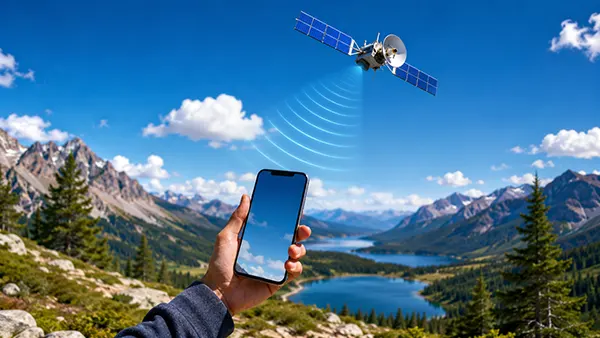
Satellite communication is no longer limited to bulky satellite phones with large external antennas. In 2026, Direct-to-Device, usually shortened to D2D, allows compatible everyday smartphones to communicate directly with satellites when conventional mobile coverage disappears. The idea is simple from the user’s point of view: a phone that normally talks to a terrestrial cell tower can, under the right conditions, establish a link with equipment orbiting hundreds of kilometres above Earth. The technology has already moved beyond laboratory demonstrations. Commercial services support emergency communication, text messaging and selected data functions, while several satellite and mobile operators are preparing broader voice and broadband services. The important detail is that D2D is not one single technology and it does not make every smartphone a universal satellite phone. Some services work with largely unmodified 4G handsets by using familiar mobile frequencies, while others require suitable chipsets, operating-system support or specific phone models. Understanding that distinction explains both the remarkable progress made by 2026 and the limitations that remain.
How Direct-to-Device Turns a Satellite into a Cell Tower
A conventional mobile phone normally searches for a nearby base station, exchanges identification information with the operator’s network and then uses that radio link for calls, messages or data. Direct-to-Device changes the location of one part of that connection rather than completely changing how the phone communicates. Instead of relying exclusively on an antenna mounted on a mast a few kilometres away, the handset can communicate with a satellite moving through low Earth orbit. Some D2D systems are deliberately designed to imitate familiar mobile-network behaviour closely enough that the handset effectively sees the satellite as another coverage source. This is why companies frequently describe their satellites as cell towers in space. The description simplifies a complicated engineering process, but it accurately represents the user experience that operators are trying to create.
Distance is the obvious challenge. A terrestrial tower may be only a few hundred metres or several kilometres from a phone, whereas a low-Earth-orbit satellite can be several hundred kilometres away and moving rapidly across the sky. The solution is not to attach a powerful dish to the handset. Most of the difficult work is moved to the satellite. Modern D2D spacecraft use highly capable antennas that can form and steer radio beams towards defined areas on Earth. Their systems also compensate for the satellite’s movement and the changing radio conditions as it passes overhead. The phone continues transmitting with the modest power available from its battery, while the orbital equipment is built to detect the much weaker signal arriving from the ground.
The mobile operator remains an essential part of many D2D services. A satellite operator may use spectrum supplied by a mobile-network partner and connect satellite traffic back into that operator’s existing network. The customer’s SIM, subscription and telephone number can therefore remain relevant when the connection moves from a terrestrial tower to satellite coverage. In practical terms, this arrangement can make satellite service resemble roaming rather than a separate communications system. It also helps explain why availability varies by operator and country. Having a technically capable smartphone is only one requirement: there must also be satellite coverage, suitable spectrum, regulatory approval, network integration and commercial support from the companies involved.
Why the Phone in Your Pocket Can Be Enough
Smartphones already contain several compact antennas because they need to communicate across multiple mobile, Wi-Fi, Bluetooth and navigation frequencies. Certain Direct-to-Device systems take advantage of the handset’s existing cellular radio rather than expecting the user to connect an external satellite antenna. Starlink Direct to Cell, Lynk and AST SpaceMobile have all developed approaches intended to communicate with ordinary mobile devices, although their network designs and commercial arrangements differ. The basic principle is to compensate for the limitations of the small handset at the satellite end of the link. Large orbital antennas, carefully controlled beams and integration with mobile spectrum make it possible to receive signals that were never originally expected to travel hundreds of kilometres into space.
There is another route to satellite connectivity. Modern smartphone chipsets increasingly include support for non-terrestrial networks, commonly called NTN. Industry specifications developed through 3GPP have been bringing satellite communication closer to mainstream cellular standards since Release 17, while subsequent work has continued to improve interoperability and performance. This approach can make future satellite features easier to integrate into phones, networks and operator services. It also means that the phrase ordinary smartphone requires some care. A phone does not need a visible satellite dish or detachable antenna, but some services still depend on a compatible modem, suitable frequency support, software and agreements between the handset manufacturer, mobile operator and satellite provider.
The experience also differs from one service to another. Some carrier-based systems are designed to switch to satellite coverage automatically when the phone cannot find a terrestrial network. Other services guide the user through the process of pointing the handset towards an available satellite. Apple’s satellite functions and Google’s Satellite SOS, for example, can display instructions that help the user maintain a usable connection. In every case, the surrounding environment matters. An open field, coastline or mountain ridge offers a much better view of the sky than a basement, tunnel or narrow street between tall buildings. Dense tree cover, steep terrain and structures can interrupt the link because the signal reaching a normal smartphone is far weaker than the signal received by a dedicated satellite terminal with a directional antenna.
What Direct-to-Device Can Actually Do in 2026
Text communication remains one of the most practical D2D applications because a short message requires comparatively little network capacity. This is why emergency messaging, SMS and basic personal communication appeared before full satellite broadband on ordinary phones. By 2026, however, the definition of useful satellite connectivity has widened. Some services can transfer data for selected applications, deliver weather or mapping information and support richer communication than a simple emergency message. T-Mobile’s T-Satellite service with Starlink, for example, supports messaging and selected applications when users are outside terrestrial coverage. Satellite data is still treated differently from ordinary 4G or 5G data because available capacity is much smaller, so operators can optimise particular applications rather than promising unrestricted high-speed internet access everywhere.
Manufacturer-integrated satellite features form another important part of the 2026 market. Apple supports satellite communication on compatible iPhones, including Emergency SOS and, in selected countries, Messages via satellite. Apple’s current guidance states that Messages via satellite is available on iPhone 14 and later in the United States, Canada, Mexico and Japan, subject to the relevant software and service conditions. Users can send iMessage or SMS messages when mobile and Wi-Fi coverage are unavailable, while Apple’s satellite network arrangements involve Globalstar and other network providers. These features demonstrate how satellite communication can become part of the normal phone interface rather than requiring a separate specialist device.
Google has taken a similar safety-oriented approach with Satellite SOS on compatible Pixel phones. By 2026, Google’s supported-country list extends well beyond the initial United States launch and includes numerous European markets such as the United Kingdom, France, Germany, Italy and Spain. The service is available on supported Pixel generations beginning with the Pixel 9 family, with model-specific exceptions, and is intended primarily for contacting emergency services when normal connectivity is unavailable. The important point is that satellite support is becoming a recognised smartphone capability rather than a niche accessory. At the same time, Apple, Google and carrier-based D2D services should not be treated as interchangeable: they use different technical arrangements, have different coverage maps and provide different sets of functions.
Which Direct-to-Device Services Are Reaching Users
Starlink Direct to Cell is one of the clearest examples of the cellular-style approach. SpaceX equips selected Starlink satellites with hardware intended to communicate directly with mobile phones and works with mobile operators that provide suitable licensed spectrum. Commercial satellite messaging began before 2026, and T-Mobile subsequently expanded T-Satellite in the United States to support selected data-enabled applications. Current T-Mobile information describes access to text communication, supported applications and satellite emergency messaging, while warning that satellite data speeds and application behaviour differ from terrestrial mobile service. The system is significant because compatible users do not need to carry a traditional satellite phone or install an external antenna before entering an area without cell towers.
Lynk Global has pursued the same broad objective through satellites designed to connect to standard mobile devices in partnership with local operators. The company says it has commercial agreements with operators serving more than 50 countries and has demonstrated satellite connections across all seven continents. Its technology has already supported two-way messaging and emergency communications, while 2026 has brought further operator trials. In July 2026, for example, OPT-NC and Lynk completed a satellite SMS test in New Caledonia using a mobile phone outside terrestrial coverage. Tests with PLDT-Smart in the Philippines have also demonstrated messaging and data-related use cases. Such projects show that D2D deployment is expanding geographically, although a successful trial or regulatory licence should not automatically be interpreted as continuous nationwide commercial coverage.
AST SpaceMobile represents another major route towards broader satellite cellular broadband. Its unusually large satellite antennas are designed to communicate directly with standard smartphones and support more demanding services than occasional text messages. Demonstrations have included voice, data and video connections using ordinary handsets, and the company has agreements with numerous mobile operators. By 10 August 2026, AST SpaceMobile reported 13 spacecraft in orbit and partnerships with more than 60 mobile-network operators collectively serving over three billion subscribers. It was preparing to begin beta services with selected strategic partners as its constellation expanded. Vodafone and AST have also created Satellite Connect Europe to support future European D2D services. These developments are substantial, but the distinction between successful demonstrations, beta availability and broad continuous commercial coverage remains important when describing the state of the technology in 2026.
Why Direct-to-Device Still Has Coverage and Capacity Limits
The disappearance of the external antenna does not remove the laws of radio communication. A smartphone is a small, battery-powered device, and a satellite has to serve a very large geographical area from orbit. The available capacity must therefore be shared between users inside each satellite beam. A terrestrial mobile network can place many base stations in a busy town and reuse frequencies across relatively small areas. A satellite cannot provide the same density of radio resources to thousands of people gathered in one place. This is one reason the GSMA continues to describe D2D as a complement to terrestrial networks rather than a replacement for them. Satellite coverage is particularly valuable where building a tower is difficult or uneconomic, while conventional mobile infrastructure remains much better suited to cities, stadiums, transport hubs and other areas with heavy data demand.
Visibility of the sky is another practical limitation. The signal may travel hundreds of kilometres between a phone and a spacecraft, yet the final few metres can still determine whether the connection works. A user beneath open sky may establish a link while somebody inside a concrete building nearby receives nothing. Mountains, dense woodland, deep valleys and tall structures can block or weaken the path. Satellite movement can also produce temporary gaps if there is no suitable spacecraft available in the required direction. Larger constellations reduce these interruptions because another satellite can take over more quickly, but coverage is not automatically identical to the continuous indoor service people expect from a mature terrestrial network.
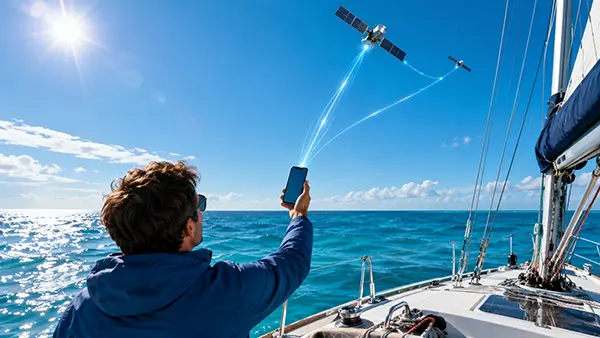
Users should also expect satellite data to behave differently. Sending a short emergency message is far less demanding than streaming high-resolution video, synchronising large photo libraries or downloading several gigabytes of files. Even when a D2D system supports broadband functions, network operators may prioritise particular services or optimise applications for limited satellite capacity. Searching for and maintaining a weak satellite connection can also consume more battery power than ordinary operation, making power management relevant during long periods away from terrestrial coverage. For hiking, sailing, remote driving or emergency preparation, satellite connectivity is therefore best regarded as an additional safety and communications layer rather than a reason to abandon offline maps, downloaded information, spare power or sensible journey planning.
What Smartphone Users Can Expect as D2D Develops
The next stage of Direct-to-Device development is likely to feel less like using a special satellite feature and more like moving between different parts of the same mobile network. Standardised NTN support is gradually appearing across chipsets, smartphones and operator infrastructure. In 2026, companies are already testing capabilities associated with newer 3GPP specifications, including improvements intended to make satellite mobility and handovers more practical. This does not mean existing phones will suddenly gain every future satellite feature through a software update. Hardware frequency support and modem capabilities still matter, but increasing standardisation should give manufacturers and operators a clearer common framework for building satellite communication into future consumer devices.
More satellites should also improve what users can do. A larger constellation can reduce the time between satellite passes, increase available capacity and make connections more continuous. That creates a path from emergency messages towards ordinary messaging, voice and progressively richer data services. AST SpaceMobile is building towards cellular broadband from orbit, Starlink continues expanding Direct to Cell arrangements with mobile operators, and Lynk is developing beyond its established messaging use cases. Europe, North America, Asia-Pacific and other regions are all seeing operator partnerships, trials or regulatory work. The pace will not be identical everywhere because spectrum licences, national rules, satellite deployment and local operator agreements determine when a service can actually be activated.
For consumers, the most useful approach in 2026 is to check four things before relying on satellite connectivity: the exact smartphone model, the mobile operator, the country where the phone will be used and the functions that the service supports there. Keeping the operating system and carrier settings current is also important, and phones offering a satellite demonstration mode can be tested before a remote journey. Direct-to-Device is already changing the meaning of a mobile dead zone, particularly for emergencies and basic communication. It has not created unlimited internet access from every point on Earth, and ordinary mobile towers will remain the main source of everyday connectivity. What has changed is that losing sight of the nearest cell tower no longer necessarily means losing every means of communication: for a growing number of smartphones, the next available connection may now be moving across the sky.