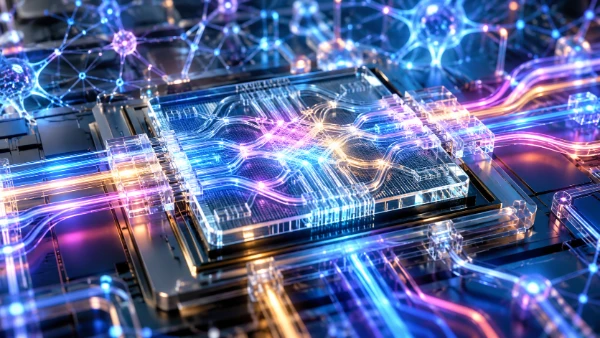
Artificial intelligence has become closely associated with large GPU clusters, but researchers are developing another way to perform some of the calculations behind neural networks: using light. Optical neural networks, also known as photonic neural networks, replace selected electronic operations with optical ones carried out by lasers, waveguides, interferometers and other photonic components. The attraction is straightforward. Light can move and process many signals in parallel, potentially reducing latency and energy use for calculations that conventional AI hardware performs repeatedly. By 2026, the field has progressed well beyond simple laboratory demonstrations. Researchers have shown increasingly complex photonic processors, end-to-end optical inference and even forms of on-chip neural-network training. These systems are not about removing electronics from AI entirely, nor are they ready to replace every GPU in a data centre. Their importance lies in showing that some of the most demanding mathematical work inside AI models can be performed by physical properties of light rather than billions of electronic switching operations.
Why AI Researchers Are Turning from Electrons to Light
Modern neural networks depend heavily on matrix multiplication. Whether a model is recognising an object in an image, analysing a spoken sentence or processing information inside a large language model, it repeatedly multiplies large collections of numbers and combines the results. GPUs became the dominant AI processors because their many computing cores can perform large numbers of these calculations in parallel. However, increasing model size requires more processors, more memory movement and more communication between chips. That creates a growing energy and infrastructure challenge. The calculations themselves matter, but moving data between memory, processors and separate accelerator chips can consume substantial time and electricity as well.
Photonics offers a fundamentally different way to perform certain mathematical operations. Instead of representing information only as electrical values travelling through transistors, a photonic processor encodes information into properties of light. Different optical signals can pass through carefully designed circuits and interact in ways that naturally implement mathematical transformations used by neural networks. Several wavelengths can also travel through the same optical path at once, allowing multiple streams of information to be processed simultaneously. This parallelism is one reason photonic computing attracts attention for AI: the hardware does not always have to reproduce a complex mathematical operation through a long sequence of individual electronic instructions.
The difference does not mean that photons are universally better than electrons. Digital processors remain exceptionally good at memory access, logical operations, control tasks and general-purpose computing. Optical hardware is strongest when a workload contains large, repetitive mathematical transformations that can be mapped efficiently onto photonic circuits. Consequently, many of the most realistic designs are hybrid systems. Optical components perform the operations for which light offers an advantage, while electronic processors handle memory, control, data conversion and other parts of the neural network. The goal is therefore not simply to build a computer made entirely from light, but to place photonics where it can reduce the workload traditionally assigned to GPUs and other digital accelerators.
What Actually Happens Inside an Optical Neural Network
A conventional neural-network layer receives a set of values, multiplies them by learned weights and passes the resulting information to the next layer. In a photonic neural network, the input values can be converted into optical signals and sent through an arrangement of optical components configured to represent those weights. Interferometers, modulators, waveguides, microring resonators and related devices can alter the phase or intensity of the light. When the signals combine, the physical behaviour of the optical circuit produces the required mathematical transformation. A detector can then convert the resulting light back into an electrical signal when necessary.
One major benefit is that light offers several forms of parallelism. Separate wavelengths can carry independent data through the same optical circuit, while spatially separated beams or different optical modes can represent additional information channels. Researchers can therefore design processors in which many values are handled at the same time rather than passed sequentially through the same electronic resources. This does not make computation literally instantaneous: lasers, modulators, detectors, memory and control electronics still have their own limits. It does, however, allow some large matrix operations to be implemented with very low latency once the optical circuit has been configured.
Another useful distinction is between free-space optical neural networks and integrated photonic neural networks. Free-space systems manipulate beams travelling through optical elements such as lenses, spatial light modulators or diffractive layers. Integrated systems place much of the optical circuitry onto compact chips, often using manufacturing techniques related to those used for semiconductor devices. The integrated approach is especially important for future commercial hardware because small photonic circuits can potentially be combined with conventional electronic components. Free-space systems, meanwhile, can take advantage of very large optical fields and extensive spatial parallelism. Research in 2026 continues in both directions because each approach solves different scaling problems.
How Optical Neural Networks Can Learn Without Relying on a GPU
Performing inference with light is only part of the challenge. A neural network becomes useful because it has been trained: its internal weights are adjusted until its outputs become sufficiently accurate for a particular task. Traditionally, an optical neural network could perform the forward calculation using photonic hardware while a conventional computer simulated the optical system, calculated gradients and determined how the optical components should be adjusted. This still placed a significant part of training on digital hardware. It also created another problem. A mathematical simulation never represents a physical photonic chip perfectly, because real devices contain manufacturing variations, noise, temperature changes and other small imperfections.
Researchers have therefore been working on in-situ training, where the real optical hardware participates directly in learning. Instead of assuming that a software model knows exactly how every component behaves, the training procedure obtains information from the physical system itself. This can compensate for imperfections that would be difficult to reproduce accurately in a computer simulation. The idea is particularly attractive as photonic neural networks become larger. Building a precise digital model of every optical interaction inside a complicated device can eventually become an expensive task in its own right, reducing some of the advantages that optical computing is supposed to provide.
Important progress has appeared in recent years. Research published in 2024 demonstrated fully forward mode learning, a method designed to conduct much of the demanding training process directly on physical optical systems without relying on conventional backward propagation through a complete digital model. By 2026, researchers were demonstrating additional approaches to physical learning, including backpropagation-free methods. These developments do not mean that GPUs suddenly disappear from every stage of AI development. Dataset preparation, model management and many supporting calculations can still take place on conventional hardware. What changes is the location of some of the most computationally demanding neural-network operations: the photonic device itself can become part of both computation and learning.
On-Chip Backpropagation Became a Major 2026 Milestone
A particularly significant result was published by researchers from Nokia Bell Labs in Nature in March 2026. They demonstrated an integrated photonic neural network capable of performing backpropagation training on the chip. Backpropagation is central to the way most modern neural networks learn. After a network produces an output, the training process measures the error and propagates information about that error backwards through the network so that its parameters can be updated. Reproducing this process efficiently inside photonic hardware has been difficult, especially because neural-network training requires more than the linear transformations at which optics naturally excels.
The 2026 demonstration addressed a long-standing obstacle involving activation gradients. Neural networks need nonlinear activation functions between their linear layers, and training through backpropagation requires information about how those functions change. Previous photonic systems commonly depended on external digital processors to handle important parts of this process or used alternative optimisation techniques that avoided conventional backpropagation. Integrating the required training operations more closely with the physical photonic circuit reduces dependence on an idealised software replica of the hardware. That matters because two apparently identical photonic components can behave slightly differently after manufacturing or under changing environmental conditions.
This result should not be interpreted as proof that a complete modern foundation model can now be trained entirely with light. The demonstrated systems remain far smaller and more specialised than the vast GPU clusters used to train leading generative AI models. Their importance is architectural. They show that the assumption that neural-network training must always be performed on conventional electronic accelerators is no longer absolute. If techniques such as on-chip backpropagation can be expanded to larger networks while maintaining accuracy, stability and reasonable manufacturing costs, future AI systems could divide training workloads between digital processors and photonic computing engines rather than relying almost exclusively on GPUs.
What Optical AI Can Realistically Achieve After the 2026 Breakthroughs
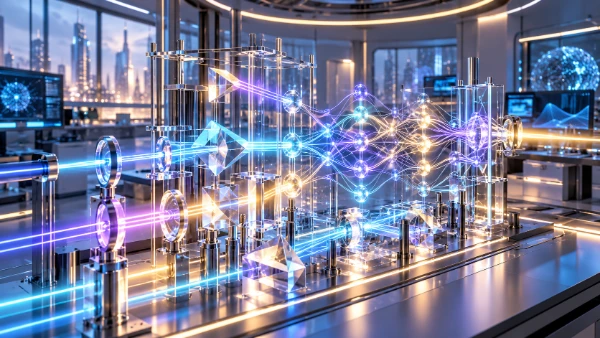
Inference is currently one of the clearest areas of opportunity for photonic AI. Once a neural network has learned its parameters, it repeatedly applies them to new inputs, creating exactly the kind of intensive matrix workload that optical hardware can handle efficiently. Research published in 2025 demonstrated increasingly deep integrated optical neural networks capable of end-to-end classification, while work published in 2026 continued to develop reconfigurable photonic tensor processors for deep-neural-network inference. Other 2026 research used techniques such as wavelength, spatial-mode and orbital-angular-momentum multiplexing to increase the amount of information that optical systems can process in parallel. Together, these projects show that the field is moving from isolated optical calculations towards more complete neural-network workloads.
The potential applications extend from data centres to edge devices. Large AI facilities need enormous amounts of computation, but they also face a communication problem: accelerators must exchange huge volumes of data. Photonics is therefore being developed not only as a computing method but also as an optical interconnect technology connecting AI processors. At the edge, the priorities can be different. A camera, sensor, autonomous machine or scientific instrument may benefit from processing information with very low latency and without sending every raw data point to a large external computer. Optical processing may be particularly useful when the original information already arrives as light, because some processing can potentially occur before the signal undergoes repeated conversions between optical and electrical forms.
Energy efficiency is another major motivation, although simple headline comparisons between optical processors and GPUs should be treated carefully. Optical matrix operations themselves can be extremely efficient, but an operational system also needs light sources, modulators, detectors, analogue-to-digital converters, digital-to-analogue converters, memory and control circuitry. The energy consumed by these supporting components can significantly affect the efficiency of the complete system. Researchers therefore increasingly assess photonic AI as a combined optical-electronic architecture rather than judging only the optical core. A very efficient photonic calculation is useful only if feeding data into it, reading the result and keeping the hardware stable do not erase most of the energy advantage.
Why GPUs Are Unlikely to Disappear from AI Computing
The strongest case for photonic neural networks is not that they will make GPUs obsolete. GPUs are programmable, mature and supported by extensive software ecosystems. A single accelerator can perform many different tasks, and developers can modify a neural network without physically redesigning the processor. Photonic hardware faces a more complicated balance between programmability and efficiency. Some architectures can be reconfigured, but increasing the size and depth of an optical network creates practical issues involving optical loss, noise, component variation and the difficulty of implementing efficient nonlinear operations. These challenges become increasingly important as researchers try to move from relatively small experimental networks to systems with millions or billions of parameters.
Memory is another fundamental limitation. Neural networks do not only calculate; they also store and repeatedly retrieve enormous quantities of parameters and intermediate data. Photonics is well suited to moving information quickly, but conventional electronic memory remains central to modern computing. This means a future photonic AI accelerator may sit beside CPUs, GPUs and memory rather than replacing them. A workload could be divided according to what each technology does best: electronic processors handling control and memory-intensive work, GPUs dealing with flexible numerical computation, and photonic engines accelerating suitable matrix operations or rapidly moving information between processors.
As of 2026, optical neural networks are therefore best understood as an emerging computing architecture rather than a finished substitute for GPU-based AI. The progress is nevertheless substantial. Researchers have demonstrated deeper integrated networks, physical training methods, on-chip backpropagation and increasingly capable photonic inference systems. At the same time, current studies continue to identify scalability, optical losses, nonlinear processing, data conversion and system integration as major obstacles. If these problems are reduced, AI computing may become more heterogeneous: instead of asking one type of processor to perform every task, future systems could combine electronics and photonics so that some neural-network calculations travel through transistors while others travel through light.