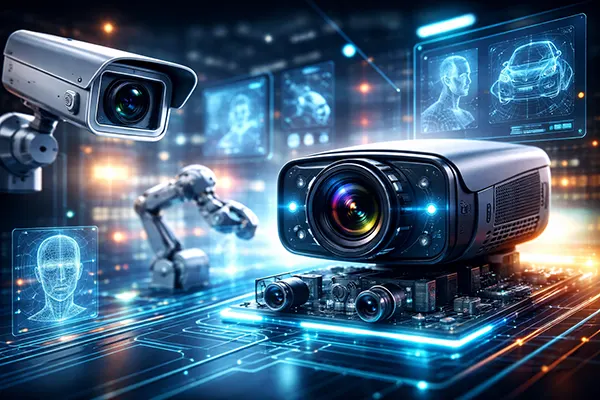
Computer vision has moved far beyond the traditional role of cameras as simple image-capturing devices. By 2025, modern computer vision systems are designed to interpret, analyse, and act on visual data in real time, supporting industries ranging from healthcare to transport and manufacturing. Understanding how these systems differ from classical camera technologies helps clarify why standard cameras are no longer sufficient for many professional and industrial tasks.
Fundamental Differences in Data Processing
Classical cameras are primarily optical tools. Their main function is to record light through a lens and convert it into a static image or video stream. Any meaningful interpretation of that data usually happens later and often requires human involvement or external software.
Modern computer vision systems operate on an entirely different principle. They combine advanced sensors with embedded computing, allowing visual data to be processed immediately. Images are transformed into structured information such as object boundaries, motion vectors, or depth maps at the moment of capture.
This shift from passive recording to active analysis enables machines to respond instantly. In applications like automated quality control or traffic monitoring, decisions are made within milliseconds, something classical camera setups cannot achieve on their own.
Role of Algorithms and Machine Learning
At the core of computer vision systems lie complex algorithms that interpret visual input. Convolutional neural networks, trained on large datasets, allow systems to recognise patterns, classify objects, and detect anomalies with high accuracy.
Unlike fixed-rule image processing used in older systems, machine learning models adapt over time. As more data is collected, the system refines its understanding, improving reliability in changing environments such as varying lighting or weather conditions.
This adaptive capability is one of the defining distinctions. Classical cameras remain static tools, while computer vision systems evolve through continuous learning and optimisation.
Hardware Architecture and Sensor Capabilities
Traditional camera hardware focuses on lenses, image sensors, and basic signal processing. While modern cameras offer higher resolutions and better low-light performance, their hardware is still designed mainly for image quality rather than interpretation.
Computer vision systems integrate specialised processors such as GPUs, TPUs, or edge AI chips directly into the device. These components handle complex calculations locally, reducing reliance on external servers and improving response times.
In addition, modern systems often use multiple sensor types simultaneously. Alongside RGB sensors, depth sensors, infrared cameras, and thermal modules are combined to create a more comprehensive understanding of the environment.
Edge Computing and Real-Time Performance
Edge computing plays a crucial role in distinguishing modern vision systems from classical cameras. By processing data locally, systems minimise latency and reduce the amount of data transmitted over networks.
This approach is essential for safety-critical scenarios such as autonomous vehicles or industrial robotics, where delays of even a fraction of a second can have serious consequences.
Classical camera setups typically depend on centralised processing, which limits scalability and responsiveness. Modern computer vision systems, by contrast, are built for decentralised, real-time operation.
Practical Applications and Functional Scope
The functional scope of classical cameras is largely limited to surveillance, photography, and video recording. Any advanced functionality requires additional software layers and manual configuration.
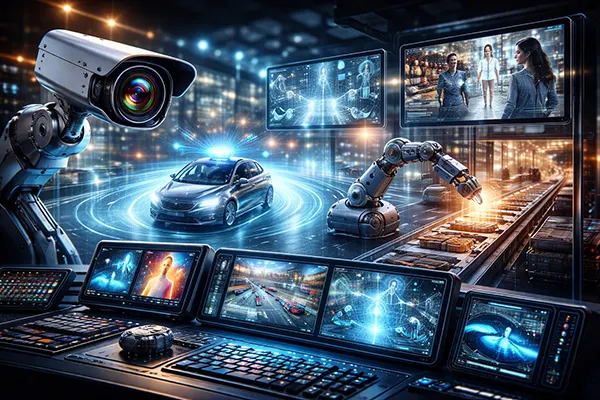
Computer vision systems are designed as complete solutions. They not only capture images but also extract meaning, trigger actions, and integrate directly with other digital systems such as control software or analytics dashboards.
By 2025, these systems are widely used for tasks such as facial recognition with privacy safeguards, medical image diagnostics, predictive maintenance, and intelligent transport management.
Autonomy and Decision-Making Capabilities
One of the most significant distinctions is autonomy. Modern computer vision systems are capable of making context-aware decisions without human intervention, based on predefined objectives and learned patterns.
For example, in manufacturing, a system can automatically reject defective products, adjust machinery settings, and log incidents for further analysis.
Classical cameras lack this decision-making layer. They depend entirely on external interpretation, making them unsuitable for environments where speed, accuracy, and independence are required.