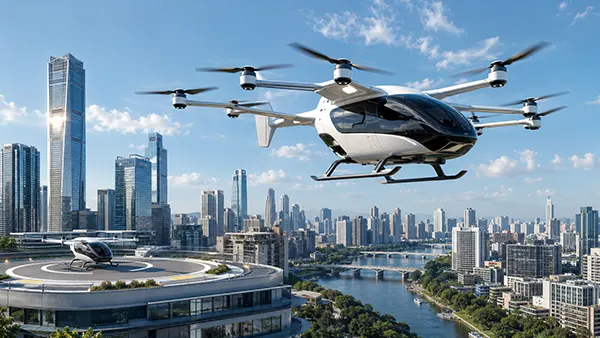
Electric vertical-take-off and landing aircraft, usually shortened to eVTOLs, have moved beyond spectacular demonstration flights and into a more demanding stage: proving that they can carry people safely, repeatedly and at a commercially useful cost. By July 2026, several manufacturers are flying full-scale aircraft, regulators have created dedicated rules, and cities are building the first purpose-designed take-off and landing facilities. China already has certified pilotless aircraft conducting controlled trial services, while Dubai is preparing an initial passenger network and the United States is using government-backed pilot projects to test real operations. Even so, urban air mobility is not yet a routine alternative to cars, trains or helicopters. The leading programmes remain limited by certification work, battery performance, weather, infrastructure, operating costs and public acceptance. The realistic picture in 2026 is therefore neither failure nor an overnight transport revolution. It is the beginning of a tightly controlled aviation service that is likely to appear first on short, valuable routes where saving time justifies a higher fare.
From Experimental Aircraft to Regulated Transport
An eVTOL combines electric propulsion with the ability to rise and land vertically, so it does not require a conventional runway. The category includes several designs. Some aircraft use separate rotors for vertical lift and a propeller for forward flight. Others tilt their propellers after take-off, allowing the wings to carry the aircraft efficiently during cruise. Multicopter designs remain supported by many fixed rotors and are generally intended for shorter journeys. Most passenger models approaching service in 2026 carry a pilot and between two and four passengers, although some are designed for autonomous operation. Their practical role is narrower than the popular image of a personal flying car. They are being developed as professionally operated aircraft flying planned routes between approved sites, often linking airports, business districts, tourist areas, islands or places separated by congested roads and water. Vertical flight removes the need for a runway, but it does not remove the need for controlled airspace, trained personnel, maintenance, charging, emergency planning and secure passenger facilities.
The United States now has a clearer legal route for bringing these aircraft into service. The Federal Aviation Administration treats many passenger eVTOLs as powered-lift aircraft because they behave partly like helicopters and partly like aeroplanes. A final rule issued in October 2024 established pilot-training and operating requirements, while certification guidance issued in July 2025 gave manufacturers a recognised way to show that their designs meet airworthiness expectations. In March 2026, the FAA selected eight projects covering 26 states for the eVTOL Integration Pilot Program. These projects can test air taxis, medical transport, cargo work, emergency response and other uses under regulatory supervision. Participation does not mean that an aircraft has completed full type certification or can immediately sell ordinary tickets. It gives regulators, manufacturers and local authorities a controlled setting in which to measure noise, route design, pilot workload, ground procedures and interaction with existing air traffic before larger services are approved.
Europe and China are following different paths. The European Union Aviation Safety Agency has developed dedicated safety requirements for VTOL aircraft and added continuing-airworthiness rules for electric, hybrid and other unconventional aircraft in February 2026. This work covers not only the original aircraft design but also the training and maintenance systems needed to keep it safe throughout its working life. China has moved further into operational trials. The two-seat EHang EH216-S received a type certificate in 2023 and a production certificate in 2024, while two operators received operating certificates in March 2025. By the first quarter of 2026, those operators had completed more than 3,000 internal trial commercial missions without a reported accident or regulatory violation. Public ticketed services were still awaiting additional operational and safety arrangements. The comparison matters: a certified aircraft, an approved manufacturer and an authorised operator are separate parts of the process, and none alone creates a complete citywide passenger service.
Which eVTOL Programmes Are Closest to Passenger Service?
Joby Aviation is among the most advanced piloted eVTOL developers. On 11 March 2026, its first FAA-conforming aircraft intended for Type Inspection Authorization began flight testing in California. This is important because the aircraft used for official certification must match the approved design and manufacturing standard, rather than being only an engineering prototype. Joby expected FAA pilots to begin formal flight testing later in 2026. Its aircraft is designed for a pilot and four passengers, with six tilting propellers, a published maximum range of about 160 kilometres and a maximum speed near 320 kilometres per hour. Those figures describe the aircraft’s potential, not the length of every commercial route. Early journeys are expected to be far shorter, leaving reserves for rerouting, changing weather and battery protection. Joby has also conducted crewed flights in the UAE and is preparing to carry its first paying passengers in Dubai, although commercial service had not begun by late July 2026.
Archer Aviation is pursuing a similar four-passenger model with its Midnight aircraft. Midnight is intended mainly for repeated journeys of roughly 20 to 50 miles, with a pilot on board and short charging periods between flights. Archer reported in May 2026 that it had completed the third phase of the FAA’s four-phase type-certification process and was already working through the final compliance phase, where the design must be supported by formal testing and analysis. The company also holds FAA approvals for pilot training, maintenance and air-carrier operations, but Midnight still requires type and production certification before unrestricted passenger service can begin. In the UAE, the General Civil Aviation Authority moved Midnight into a Restricted Type Certificate programme in May 2026. That route may permit limited initial operations while longer-term approvals continue. Archer is targeting passenger-carrying flights in 2026 in the UAE and selected US projects, yet those targets should be read as planned milestones rather than evidence of an established public network.
EHang, Eve Air Mobility, Vertical Aerospace and Volocopter show how varied the market has become. EHang’s autonomous EH216-S is smaller than Joby or Midnight, carrying two people over a published maximum range of 30 kilometres at a maximum design speed of 130 kilometres per hour. It has the strongest certification record for pilotless passenger flight in China and has operated routine commercial trials in Guangzhou and Hefei, but its short range and tightly managed operating model differ from the piloted airport-transfer services planned elsewhere. Eve’s aircraft is designed for four passengers and a pilot over journeys of up to 100 kilometres. Its full-scale prototype completed dozens of low-speed and hover flights during the first half of 2026 and was preparing for transition testing, while certification work continued with Brazil’s ANAC and validation was sought in Europe. In Europe, Vertical’s VX4 and Volocopter’s VoloCity remain active, but their timetables demonstrate that certification and funding can take longer than early industry forecasts suggested.
Where Urban Air Mobility Is Becoming Real
Dubai has the most developed plan for a recognisable air-taxi network outside China. Joby completed the UAE’s first crewed point-to-point eVTOL flight in November 2025, travelling from its Margham test site to Al Maktoum International Airport in 17 minutes. In April 2026, Dubai’s Roads and Transport Authority reported technical completion of the first purpose-built air-taxi station near Dubai International Airport. The four-storey, 3,100-square-metre facility includes two landing pads, aircraft parking, charging equipment, passenger areas and car parking. It is designed to handle up to 170,000 passengers a year. Three additional locations are planned at Downtown Dubai, Palm Jumeirah and Dubai Marina. The proposed airport-to-Palm Jumeirah flight would take about 10 minutes rather than roughly 45 minutes by road under the comparison used by the RTA. Preparations point to a launch by the end of 2026, but the final timing still depends on aircraft approval, operator readiness and completion of the full route system.
The United States is taking a broader experimental approach rather than concentrating immediately on one city network. The eight projects selected under the 2026 integration programme cover urban passenger flights, cargo, medical transport, emergency response, autonomous systems and energy-sector work. This range reflects a practical lesson: the first valuable use of electric vertical flight may not always be a downtown air taxi. In July 2026, BETA Technologies and United Therapeutics completed a multi-stage demonstration carrying an animal organ in a medical container between airports in Virginia and Maryland. Medical logistics, urgent industrial transport and connections to isolated communities can justify high operating costs because speed has direct value. These missions also allow operators to gain experience with charging, dispatch, maintenance and airspace coordination before attempting dense schedules above major cities. Passenger demonstrations by Joby and Archer are expected within selected US projects, but full commercial operations still require the relevant aircraft and production approvals.
China’s early model is based on short, controlled flights at approved sites rather than a broad network covering an entire metropolitan area. EHang reported more than 40 operating locations established by customers and partners by 2026, with routine trials at some sites. Guangzhou and Hefei have been the main showcases, particularly for tourism, demonstration flights and local low-altitude transport. This approach reduces route complexity and allows centralised supervision of pilotless aircraft. Europe and the United Kingdom are preparing partnerships while certification continues. In July 2026, Joby and Virgin Atlantic finalised an agreement for future UK services connected with Heathrow and Manchester, including proposed journeys from Heathrow to central London and from Manchester Airport to Leeds. These are route concepts, not bookable scheduled flights. Europe has strong safety rules and several aircraft programmes, but in 2026 it remains mainly in the testing, certification and infrastructure-planning phase rather than regular passenger operation.
Routes, Vertiports and the Passenger Journey
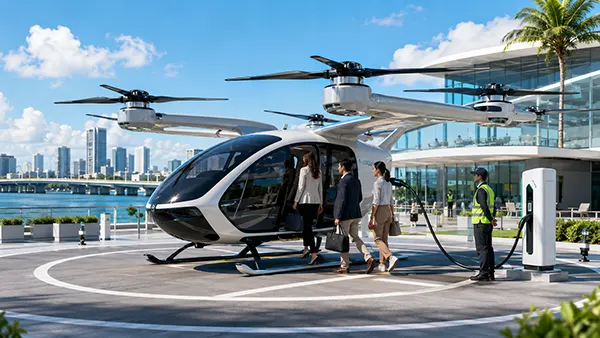
A vertiport is more than a marked rooftop where an aircraft can land. A commercially useful site needs safe approach paths, passenger separation from moving aircraft, firefighting arrangements, secure access, charging equipment, weather monitoring, maintenance support and a reliable connection to roads or public transport. It must also process passengers quickly enough to make a short flight worthwhile. Dubai’s first station illustrates the scale involved: two landing pads serve a building with parking, climate-controlled passenger facilities and dedicated aircraft areas. Even with a theoretical capacity of 170,000 passengers a year, the site would carry only a small share of the daily trips handled by a large metro station or airport terminal. Vertiports therefore need carefully chosen locations where time savings are unusually valuable. Reusing heliports and airport property may reduce construction work, but many existing sites lack the electrical supply, passenger layout or neighbourhood approval required for frequent eVTOL movements.
The strongest early routes are likely to connect places where geography or congestion makes surface travel slow and unpredictable. Airports to city centres are an obvious example because passengers already accept security procedures, luggage limits and advance booking. Cross-bay, island and river routes can also provide a clear advantage, as can journeys between large business centres that are poorly linked by rail. The aircraft’s cruising speed may make a flight last only 10 or 15 minutes, but travellers will judge the complete journey. Reaching the vertiport, checking in, waiting for boarding, transferring at the destination and allowing for weather can remove much of the advertised saving. A successful route therefore needs more than impressive speed. It needs frequent departures, simple transfers and a location close enough to the traveller’s real origin and destination. Routes that save only a few minutes over a dependable train are unlikely to support the cost of dedicated aircraft and facilities.
The first passenger experience will probably resemble a small premium aviation service rather than an airborne taxi hailed from any street. Joby, Archer and Eve are all preparing cabins for four passengers plus a pilot, while EHang’s current certified aircraft carries two people without an onboard pilot. Seating is limited, luggage capacity must be managed and passenger weight affects aircraft loading. Bookings are expected to be integrated with airline or ground-transport apps, but passengers may still need identity checks, safety instructions and assigned departure times. Weather-related changes will require rebooking or ground alternatives. No widely available final fare structure had been published for the leading Western services by July 2026, so claims that eVTOL journeys will immediately cost the same as an ordinary taxi are premature. Initial pricing is more likely to reflect scarce capacity, expensive aircraft, trained pilots and new infrastructure. Broader affordability depends on high utilisation, faster charging, longer battery life and larger fleets.
What Still Limits Large-Scale Air Taxi Networks
Battery performance remains one of the clearest physical limits. Vertical take-off consumes a large amount of energy in a short time, and aviation rules require reserves for unexpected delays, route changes or a safe alternative landing. This means a published maximum range cannot be treated as the normal scheduled distance. Operators must also protect battery life because repeated fast charging, heat and deep discharge can reduce capacity over time. The difference between current aircraft illustrates the design trade-off. EHang publishes a 30-kilometre range for the compact EH216-S, Eve targets 100 kilometres, and Joby’s larger winged aircraft is described by Dubai authorities as capable of about 160 kilometres. Yet the earliest networks focus mainly on much shorter sectors. Short routes allow more reserve, reduce exposure to weather and make it easier to return to a maintenance base. Progress in batteries will help, but reliability across thousands of cycles is more important to an operator than a single record-setting flight.
Noise is improved but not eliminated. Electric motors avoid the engine noise of a conventional helicopter, and multiple smaller propellers can reduce the most intrusive low-frequency sound. Manufacturers describe major reductions during cruise, when an eVTOL may blend more easily into urban background noise. Take-off and landing remain more noticeable because the aircraft is close to the ground and every rotor is producing lift. A single movement may be acceptable, while dozens of movements each hour could prompt a different public response. Regulators are therefore developing specific noise criteria rather than accepting general claims that electric aircraft are quiet. Weather creates another operational limit. Strong winds, thunderstorms, low cloud, icing and extreme temperatures can restrict flights, especially at exposed rooftop sites. Dubai’s desert trials were valuable partly because they tested cooling and performance in high heat. A transport service must remain dependable in ordinary local conditions, not only during carefully selected demonstrations.
The business case is equally demanding. Each flight must pay for the aircraft, batteries, maintenance, insurance, energy, the pilot, ground staff, booking systems and vertiport charges. Four passenger seats leave little room to spread those costs, especially when some flights depart partially empty. Operators want high daily utilisation, but charging, inspections, weather delays and maintenance reduce the number of revenue flights an aircraft can complete. Vertiports also need enough movements to cover valuable urban land and substantial electrical connections, while residents may oppose frequent operations near homes. These pressures explain why early services are aimed at airport transfers, premium business journeys, tourism, medical transport and other time-sensitive uses. eVTOLs can complement rail, buses and conventional taxis, but they cannot match the passenger capacity or low cost of mass transit. Their most credible role is as a specialised connector within a wider transport system, not a replacement for the streets and railways beneath them.
What 2026 Suggests About the Next Five Years
The central lesson of 2026 is that urban air mobility is entering a controlled introduction, not immediate mass adoption. The first services are likely to use small fleets, a few fixed routes and conservative operating conditions. Flights may initially take place during the day, in acceptable weather and with substantial separation from other traffic. Airports, tourist districts, medical routes and journeys across natural barriers offer the clearest starting points because their value can be measured. Dubai may become the first city with a purpose-built Western air-taxi network, while China is already collecting operational experience with autonomous aircraft at controlled sites. US pilot projects will produce data across a wider set of missions. Success should be judged by safe repetition, dispatch reliability, maintenance performance and public response rather than by the number of demonstration events. A modest service that runs consistently will teach the industry more than an ambitious network announced before aircraft and facilities are ready.
Autonomy will develop at different speeds in different jurisdictions. EHang has shown that pilotless passenger aircraft can be certified and supervised through central ground systems in China. Most Western passenger programmes are beginning with a pilot on board because regulators and travellers already understand that operating model. Removing the pilot could eventually free another seat and reduce one of the largest recurring costs, but it also raises harder questions about remote supervision, lost communications, cybersecurity, emergency decisions and responsibility during unusual events. The transition is therefore unlikely to happen simply because the aircraft can fly automatically. Operators will need extensive evidence from piloted service, dependable communication links and clear rules for ground controllers. During the late 2020s, increasing automation is more likely to assist pilots and dispatchers before it replaces the person in the cockpit on ordinary urban passenger routes.
Between 2027 and 2031, several eVTOL types may obtain full certification, while some programmes will be delayed, redesigned, sold or discontinued. That consolidation is normal in a new aircraft sector where development requires years of testing and very large investment. Cities with supportive regulators, existing aviation sites, reliable electricity and severe transport bottlenecks will have the strongest chance of maintaining early networks. The decisive test will not be whether an eVTOL can fly above traffic; that has already been demonstrated. It will be whether operators can provide safe, frequent and financially sustainable journeys after accounting for access time, weather, charging and maintenance. If they can, electric vertical flight may become a useful airport link and regional connector in selected cities. It is unlikely to fill urban skies with private flying cars. The more realistic outcome is a small but visible new branch of civil aviation serving routes where vertical access and time savings deliver genuine value.