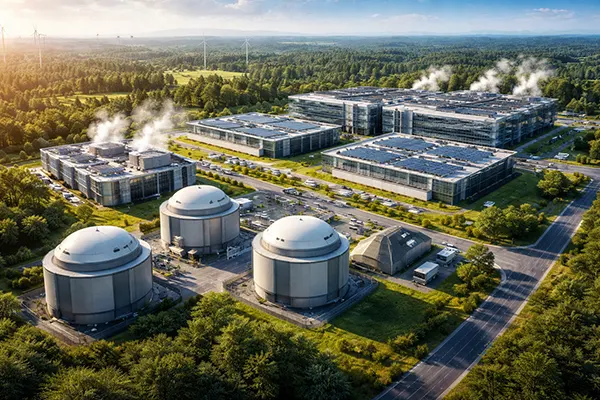
Global electricity demand from data centres is rising at a pace few expected even five years ago. The rapid expansion of artificial intelligence workloads, hyperscale cloud services and edge infrastructure has turned reliable baseload power into a strategic asset. Against this backdrop, small modular reactors (SMRs) are increasingly discussed as a potential low-carbon energy source capable of supplying large digital campuses. The question is no longer theoretical: can commercially viable SMR–data centre projects realistically be delivered before 2030, or is this still a post-2035 scenario?
Why Data Centres Are Driving Interest in SMRs
According to the International Energy Agency, global electricity consumption by data centres could exceed 1,000 TWh annually by 2026, with AI-focused facilities accounting for a significant share of growth. In the United Kingdom and parts of the European Union, grid connection queues already stretch for years, particularly in regions attractive to hyperscale operators. This constraint is forcing technology firms to reconsider long-term energy strategies, including direct procurement from nuclear assets.
Unlike traditional gigawatt-scale nuclear plants, SMRs are designed with capacities typically ranging from 50 to 300 MW per unit. This scale is closer to the needs of large data centre campuses, which often operate in the 100–500 MW range. The modular approach aims to shorten construction timelines and reduce financial risk through factory fabrication of key components.
Energy reliability is central to the discussion. Data centres require near-constant power availability, often above 99.999% uptime standards. While renewables combined with storage can cover part of this demand, long-duration storage at scale remains costly. SMRs, in theory, could provide stable, low-carbon baseload power without the intermittency challenges associated with wind and solar generation.
Technical and Regulatory Readiness as of 2026
As of 2026, no SMR project has yet entered full commercial operation in Western Europe or North America. However, several designs are advancing through regulatory processes. In the United States, the Nuclear Regulatory Commission continues to evaluate advanced SMR designs, while the UK’s Generic Design Assessment process includes Rolls-Royce SMR among the leading candidates.
Licensing remains one of the primary bottlenecks. Even with modularisation, nuclear projects must comply with stringent safety, environmental and security requirements. Regulatory timelines often extend beyond five years, which compresses the window for commissioning projects before 2030 unless preparatory work is already well advanced.
Supply chain maturity is another factor. While the concept of factory-built modules promises standardisation, large-scale manufacturing facilities dedicated to SMRs are only now being planned. Without proven serial production, cost reductions may not materialise quickly enough to make early projects economically competitive.
Economic Viability and Commercial Models
The capital cost of first-of-a-kind SMR units is expected to be high. Estimates published by industry analysts in 2025–2026 suggest overnight costs could exceed £5,000 per kW for early deployments. For a 300 MW reactor, this implies multi-billion-pound investment levels, comparable to large offshore wind farms but concentrated in a single asset.
For data centre operators, long-term power purchase agreements (PPAs) would likely form the backbone of any commercial arrangement. Hyperscale firms with strong balance sheets could commit to 15- to 25-year contracts, improving bankability. However, nuclear projects typically require revenue certainty over even longer horizons to secure financing at reasonable rates.
Government support mechanisms may prove decisive. In the UK, the Regulated Asset Base (RAB) model is already being applied to large nuclear projects, spreading construction risk across consumers. Whether a similar framework will be extended to SMRs dedicated partly or wholly to private industrial consumers remains under active policy discussion in 2026.
Risk Allocation and Investor Confidence
Investors assess nuclear projects primarily through the lens of construction risk, regulatory uncertainty and political stability. Delays in recent large-scale nuclear builds in Europe have made financiers cautious. SMRs promise lower complexity, but until at least one project is delivered on time and on budget, risk premiums are likely to remain elevated.
Technology companies, on the other hand, are under growing pressure to decarbonise operations. Many have set 24/7 carbon-free energy targets rather than annual matching. This shift strengthens the business case for firm low-carbon sources such as nuclear, particularly in regions where renewable penetration is already high but grid stability is strained.
A hybrid model is emerging in discussions: co-located SMRs supplying both a data centre campus and the local grid. Such an arrangement could diversify revenue streams, reduce exposure to a single off-taker and align with national energy security objectives. Whether contracts can be structured in time for projects to break ground before 2030 remains uncertain.
Realistic Scenarios for 2030
Given current regulatory timelines, only projects already in advanced planning stages have a realistic chance of partial operation by 2030. In the United States, certain advanced reactor demonstrations supported by federal funding may begin construction before 2027, but commercial data centre integration would likely follow initial grid-connected pilots.
In the UK, Rolls-Royce SMR aims for deployment in the early 2030s, subject to successful completion of regulatory review and site selection. Even under an accelerated pathway, commissioning before the end of the decade would require exceptional coordination between developers, regulators and energy customers.
Elsewhere, countries with streamlined approval processes and strong state backing, such as Canada, may see earlier SMR deployment. Ontario’s Darlington site, for example, has advanced plans for a small modular reactor, although integration with private digital infrastructure has not yet been formalised as of 2026.
Strategic Outlook for Technology and Energy Sectors
From a strategic perspective, the most plausible near-term outcome is not widespread SMR-powered data centres by 2030, but rather the signing of binding agreements and the launch of flagship projects. These early cases would serve as reference models for replication in the 2030s.
Technology firms are increasingly engaging directly with nuclear developers, signalling that energy sourcing is now part of core infrastructure strategy rather than a peripheral procurement issue. This shift could accelerate alignment between reactor deployment schedules and digital expansion plans.
By 2030, the sector may see the first concrete evidence that SMRs can underpin large-scale digital operations, even if full commercial roll-out remains several years away. The feasibility question is therefore nuanced: technically possible in selected jurisdictions, financially complex, and heavily dependent on regulatory execution over the next three to four years.